Making homemade cleaning products has been a trend for a few years now, but did you know that you can make your own homemade bleach?
This is one of my favorite all natural homemade cleaning recipes. If you are making the switch to a non-toxic, chemical free home you will definitely want to try this homemade bleach alternative recipe. With just a few simple ingredients from your pantry you can make a homemade natural bleach alternative that will brighten your whites and disinfect germs without toxic fumes or skin irritation.
This recipe is also seriously economical with a half gallon only costing 84 cents.

Homemade Bleach Recipe
Spring is officially here and I always get the urge to do some spring cleaning this time of year. Like many of you I like to make some of my own cleaning supplies. Not only is it economical but it’s also better for the environment and the health of our families and pets.
I’ve come to the conclusion that you can make pretty much anything you can buy from the store. This is especially true with cleaning products. In the past I have shared my recipes for laundry detergent and dishwasher detergent, today I’m going to share my recipe for non-toxic homemade bleach.

We usually have a jug of bleach under the kitchen sink or in the laundry room at all times. Truthfully I don’t really like to use it. Not only is chlorine bleach a super harsh chemical but the fumes really bother me too.
I wrote a blog post about how to reverse tie dye with bleach a couple of years ago, so yes, I do use bleach occasionally and it comes handy for some craft projects, but when it comes to daily cleaning I prefer my own homemade version better.
I like to reserve chlorine bleach for those times when I have nasty pet messes to clean up or our family comes down with a bout of the stomach flu.
What is Chlorine Bleach Anyways?
Let’s talk about chemistry!
Chlorine bleach is sodium hypochlorite, a solution of chlorine and diluted sodium hydroxide. When exposed to the air, the chlorine evaporates as a gas from the bleach solution at a high rate, this is what causes strong smell associated with chlorine bleach.
Bleach is nasty stuff. It stinks and the fumes are not safe for people or animals to breathe in.
Chlorine fumes can cause everything from mild headaches and dizziness to internal tissue damage of the nasal, pulmonary, and bronchial tissues, if the exposure is either severe or prolonged.
Sodium hydroxide is highly corrosive, and even though it has changed states here due to the chemical reaction with water and chlorine, the mixture is still corrosive.
Despite the health and safety concerns, chlorine bleach is relatively shelf-stable and has been widely tested and approved as effective against multiple viruses, microbes, bacteria, protozoa, and other pathogens on both hard and porous surfaces, as well as an effective whitening agent.
Always remember, never mix chlorine bleach with other cleaning products. For example when vinegar is mixed with bleach it creates toxic chlorine gas. Adding any weak acid to bleach ( vinegar, lemon juice etc) will release toxic chlorine and chloramine vapors.
If you are dead set on working with chlorine bleach to disinfect your home, use this recipe to make your own diluted diy bleach cleaner.
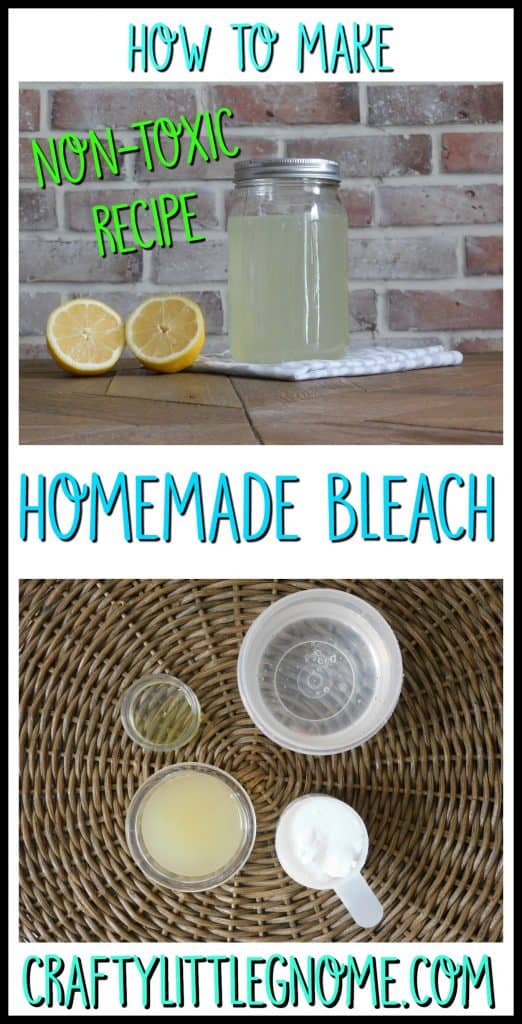
Homemade Bleach Alternative Using Natural Ingredients
Makes 1 quart
- ½ cup 3% hydrogen peroxide
- 2 tablespoons lemon juice or white vinegar OR ½ teaspoon citric acid
- 3 ¼ cups water
- 5 drops lemon essential oil
Multiply everything by 4 to make a gallon
Directions
- Pour peroxide, lemon juice, citric acid (if using), and lemon essential oil into a blue or amber glass bottle. Swish around until citric acid is dissolved.
- You can use juice from a fresh lemon or bottled lemon juice. You can buy a large bottle of lemon juice from the dollar store for only one dollar which is usually more economical.
- The lemon juice is actually an important part of this recipe, so don't skip it. The citric acid acts as a whitener, a very mild disinfectant, and as a water softener (thus allowing stains to be lifted out more easily).
- Fill the rest of the jug with distilled water and use as you would bleach.
- Mix together and store in a large jug. I pour mine into a smaller bottles for convenience. Since the peroxide will oxidize and eventually lose strength it’s best to use the homemade bleach within a month.
- You need to keep this homemade bleach solution in a cool, dark place and preferably in a dark bottle. Exposure to light will make it oxidize more quickly.
Ideas for Reducing the Exposure of Home made Bleach to Light
- Keep old peroxide bottles and keep a spray nozzle from another bottle.
- Wrap the spray bottle in a brown paper lunch bag and secure at the top.
- Cover the spray bottle with construction paper or wrapping paper and make it decorative
A Few Notes About Hydrogen Peroxide
Hydrogen peroxide can be just as corrosive as chlorine bleach, depending on its strength, and it's more volatile at higher concentrations, yet hydrogen peroxide has been approved as an effective household disinfectant by the EPA since 1977.
Hydrogen peroxide can be found in multiple potencies. The kind typically available at a common drugstore is a diluted 3% solution (this is what we are using in this recipe)
However, it can also be found in industrial and food grade strength, which are all above 30% dilution. This makes a much stronger cleaner, but it's also extremely volatile at that strength. It can burn your skin, severely corrode certain materials (such as vinyl countertops), tarnish metal, and explode if stored improperly. It’s best to leave this strength to the professionals and I don’t recommend it for home use.
So now that you have your bleach made, how do you use it?
How to Use Homemade Bleach For Laundry
Use 1 cup of safe bleach per load of laundry.
For laundry you should dilute the solution for colored clothes so they don’t fade. If you do use the cleaning recipe for laundry, use only ¼ cup and test on light colored fabrics first.
Results may vary if you have hard water.
Washing Tips
If your clothes are very dirty or have tough stains you might need to do a few extra steps:
- soak dirty clothes and solution in the washing machine overnight; add detergent and leave it to soak. Continue the wash cycle in the morning
- wash dirty laundry twice in a row before drying
- wash in hot water
Washing White Clothes
If you need to brighten your white laundry or white linens, take a cup of your homemade bleach and add it to a gallon or two of water. Soak your linens for at least an hour before running through a wash cycle.
BONUS BENEFITS OF USING NATURAL BLEACH:
- Brightens clothes
- Natural fresh scent
- Doesn’t irritate skin
- No toxic fumes
- Helps kill bacteria as a natural disinfectant
How Does the Cost of Homemade Bleach Compare To Store-Bought Chlorine Bleach?
- hydrogen peroxide: $0.07
- lemon juice: $0.18
- lemon essential oils: $0.38
- baking soda: $0.21
Total cost for ½ gallon all-natural homemade bleach alternative is just 84¢!
Store-bought bleach typically costs 3¢ per ounce, but the homemade version costs just 1¢ per ounce but without the harmful chemicals.
To keep the cost as low as possible try to buy your ingredients for as cheap as possible. Aim for less than $1 for a 32oz bottle of hydrogen peroxide and buy other ingredients in bulk or online (with free shipping)
The great thing about making your own cleaning solutions is that a lot of the ingredients like citric acid, lemon and essential oils can be used in different recipes for different kinds of cleaners. It is also safe if you have a septic system.
Have you ever tried making homemade bleach or other cleaning products before? Tell me about your experience in the comments!

Hi I’m Adrienne Carrie Hubbard. I believe a rich life comes not from the things you have, but the things you do; the experiences you create and the people you meet along the way. Thanks for hanging out!
angelafennell says
Could I use lemon essential oil? If so, how many drops would you recommend for your recipe?
Cleaner Jobs says
Wow, it's a easy idea for homemade bleach! I would like to make it.
Anonymous says
I woukd think it's probably not any different than using bleach in a septic system 😉
Anonymous says
Does anyone know if this is safe to use if you have a septic system ?
Anonymous says
Smart!
Anonymous says
has anyone tried this in the laundry? spray on stains or added to the cycle? i make my own laundry detergent but love to have an extra boost for the whites to keep them bright. thanks!
Anonymous says
I have an old ceramic sink and I haven't found any natural remedy that cleans the stains like 1/2 bleach and 1/2 water. I scrub with baking soda and other things I've read but just don't get the clean look. Any suggestions?
maids Eden Prairie says
Does this really work? This will certainly be amazing if it does. I got kids at home and sometimes it is so fearsome to use so many chemical products for every different area. I will really have this a try. I hope it works.
Anonymous says
Holly, I checked out your recipe for the fabric softener. I am wondering if it can be used in an HE washer? If it can, that would be wonderful, and I would absolutely give it a try.
Danielle says
I just wanted to let you know I featured you on Blissful and Domestic today.
Stop by and grab a button:>
http://blissfulanddomestic.blogspot.com/2012/03/14-homemade-tips-and-tricks.html
Christi says
Great idea! This is on my to do list, using the peroxide bottle to contain it all!
Anonymous says
Thank you so much for sharing! I have read that the peroxide actually breaks down within hours, but I never knew why. That made me skeptical about trying this. Now that I know about the dark bottle, I'll give this a try.
Rory says
Great idea, will definitely try this.
I don't usually like keeping bleach in the house, but my cleaner loves it. So maybe I'll make this for her instead.
Kristina Unhjem says
I just made this and it worked great for cleaning the bathroom. I'm going to try it on the kitchen sink next. Thanks for the great homemade cleaning recipe. I have to get the peroxide from the pharmacy here in Norway!
Inspire Me Heather says
I had no idea you could make your own bleach - thank you! I've got this linked to my household cleaners post too today, your recipe is a keeper!
Anonymous says
I just stole a squirt top from a generic cleaning bottle and stuck it on my dark brown hydrogen peroxide bottle and there you go! The added lemon juice would be nice though.
Anonymous says
Can't find a dark bottle? Paint the outside of a clear one, or, wrap it with duct tape.
Holly says
I will have to try this! I wonder if it will work in a spray bottle - I have tried regular bleach (diluted with water) in a spray bottle for my bathroom, but the bleach ruins the rubber in the spray mechanism and it won't work after a while. 🙁
My favorite homemade cleaning recipe is homemade fabric softener
Adrienne Audrey says
Hi Lisa, Lemon has antibacterial properties in addition to smelling great. The main star of this cleaning recipe is the peroxide.
Adrienne Audrey says
Hi Holly, I've had the same experience with regular bleach ruining a spray bottle. I haven't had this happen with the homemade bleach but I use a smaller bottle because of this and only make small batches at a time.